TIR Library Newsletter: Our Book Recommendation
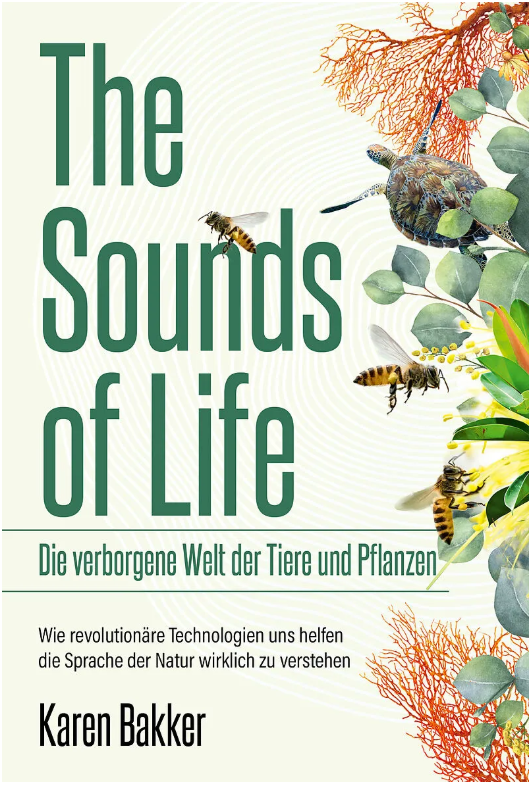
In its first library newsletter of 2025, the Foundation for the Animal in the Law (TIR) again presents selected new additions such as books, articles and films on animal-related topics. The current issue focuses on the book ‘The Sounds of Life - The Hidden World of Animals and Plants’, which brings the apparent silence of living organisms to life.
April 4, 2025
Modern technologies determine our daily lives. Depending on how they are used, they are either a curse or a blessing. With regard to the animal and plant world, however, artificial intelligence could increasingly help to promote the protection of individual animal species and their habitats. This book, ‘The Sounds of Life - The Hidden World of Animals and Plants’, shows how existing bio- and eco-acoustic methods can be expanded, intensified and used specifically for animal welfare projects or the decoding of animal communication data using digital technology and AI. The author tells fascinating stories from the beginnings of research into animal voices to the use of current digital technology. Animals that were previously considered mute in science because the sounds and vibrations they emit cannot be detected by the human ear are now finally being heard thanks to digital support. However, what new acoustic technologies are bringing to light is nothing new for many indigenous peoples, as they also have ways of capturing and analysing non-human sounds and using them to their advantage.
Thanks to so-called passive acoustic monitoring (PAM), which collects data from three-dimensional space, non-human sounds from living organisms can be recorded in places that are difficult to access. This non-invasive method is very precise, can be used day and night and does not disturb or influence the animals in their activities. It therefore enables real documentation of animal life from a distance, whereas previous observations could only take place on site and at certain times. The sounds recorded can also be used to protect endangered species. On the Atlantic and Pacific coasts of North America, bioacoustic-based monitoring systems are currently being used to determine the position of whales. Ships are even instructed to slow down and a fishing stop is ordered. Acoustic recordings can also serve as deterrent alarm signals. Low-frequency signals, for example, reduce the bycatch of sea turtles, as the animals stay away from the nets due to the corresponding vibrations. Climate change is known to have a significant impact on the oceans, with corals in particular suffering from the higher water temperatures. As a result, this also leads to a life-threatening situation for people, especially in terms of coastal protection. With the help of so-called playbacks and the playing of sounds from intact reefs, fish larvae could be reintroduced to degenerated reefs and a complete die-off prevented.
Another important aim of the book is to raise awareness of the effects of noise pollution on animals and plants.
Bakker explains how human noise can disrupt natural communication channels and affect the behaviour and survival of many species. Noise pollution, for example in waters with heavy shipping traffic, naval sonar, munitions explosions or gas and oil extraction, can lead to behavioural changes, hearing damage and even the death of aquatic life.
While the book is scientific at its core, providing clear explanations of bioacoustics, ecoacoustics, infrasound impulses and other similar concepts, it is also poetic and touching with its stories. This is particularly evident in the identification or decoding of communication characteristics with our fellow creatures.
However, the new technologies also harbour the risk that further urgent measures to protect the animals and their habitat will not be implemented, even though they are urgently needed. Instead of just sending out alarm signals to warn sea turtles of nets, the use of trawl nets should be banned and fishing generally reduced. It is also questionable whether these new infrastructures will effectively change our relationship with the earth and all living creatures. It would be desirable for people to develop a better understanding of nature and their fellow creatures through this new way of listening. It is also important that precautions are taken to ensure that digital technology is not misused or exploited, which ultimately harms animals and plants. Technology alone will not help us, writes author Karen Bakker, and argues in favour of more species and climate protection.
Karen Bakker (1971-2023) studied literature and linguistics and completed her doctorate at Oxford University. She was a professor at the University of British Columbia and received numerous honours during her career, including scholarships from Stanford and Harvard University. The work ‘The Sounds of Life - The Hidden World of Animals and Plants’ is available in bookshops or can be viewed by appointment during opening hours in the TIR library, where reading and workstations are available.
The original English edition was published in 2022 under the title ‘The Sounds of Life - How Digital Technology Is Bringing Us Closer to the Worlds of Animal and Plants’. Current new additions to the TIR Library are presented in the TIR Library newsletter.
Further information:
- Article (in German): Talking Turtles - Junger Forscher entdeckt: Schildkröten können sprechen by Irène Dietschi
- Book: Animals: Art, Science and Sound by Malini Roy, Cam Sharp Jones, Cheryl Tipp Cheryl, David Attenborough (introduction)
- Book (in German): Im Gespräch mit wilden Pferden by Marc Lubetzki
- Article: Common Evolutionary Origin of Acoustic Communication in Choanate Vertebrates by Gabriel Jorgewich-Cohen, William Simon Townsend et al., (Nature Communications (2022) 13: 6089)
- Information OceanCare: Underwater Noise Pollution